Commercialized 3D Print Technologies


Story behind
bar ribbon fixture in
Jumeirah Marsa Al Arab
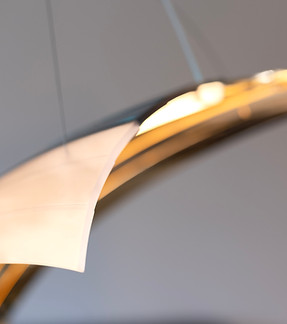
Picture shown as mock up polished gold version, might be different with the final production ones.
Suspended above the bar at Marsa Al Arab, the chandelier unfolds like a ribbon of light—fluid, expressive, and quietly commanding. Conceived and realized by YAOJUN BUILD, it is a piece that dissolves the boundary between sculpture and illumination.
Each element is singular. No segment repeats, no curve is identical. Such individuality resists the logic of traditional making, where molds impose uniformity. Instead, the chandelier is brought to life through advanced multi-material resin 3D printing—an approach that allows every gesture of the design to remain intact, unrestrained by tooling, and faithful to its organic intent.
Within its flowing structure, light is not applied, but embedded. An ultra-thin LED line traces the form from within, held in place by precisely printed internal frameworks and softened through a continuous silicone diffuser. The glow is diffused, intimate—revealing the form as much as it defines it.
Material becomes light’s counterpart. Translucent blue resin elements capture and refract illumination, subtly shifting in tone and depth as the viewer moves through the space. These are seamlessly UV-bonded with complementary hues, forming a layered chromatic composition that feels both natural and deliberate.
This is not merely a lighting fixture, but a living presence—shaped by technology, guided by craftsmanship, and animated by light. A quiet expression of how contemporary making can evoke something timeless.

24 Days Production
3D printing unlocks a new kind of magic—where ideas flow freely and forms follow no rules.
It empowers designers to bring their most ambitious, dreamlike concepts into the physical world, without compromise.
Process
Conceived to occupy and define the volume above the bar, the installation unfolds as a continuous, organic composition—its form guided by natural turning angles that follow an intuitive spatial rhythm. Each element responds to the next, creating a sense of movement suspended in air while maintaining visual balance from every perspective.
To achieve this, the entire suspension system was re-engineered. The positioning and calibration of each aircraft cable were meticulously adjusted to ensure equilibrium across the fully assembled structure, allowing the piece to float with precision and stability.
A series of specially designed, 3D-printed connecting bridges were developed as an integral safety mechanism during installation. These engineered connectors are designed to fail in a controlled manner—self-breaking under excessive stress rather than transferring force into the resin components. This approach prevents cracking, reduces localized bending, and protects the integrity of each individual element throughout the installation process.
Lighting was approached with equal precision. A custom-engineered silicone LED diffuser, produced through advanced printing techniques, integrates seamlessly within the structure. Its internal geometry is optimized to deliver soft, even illumination while maintaining an exceptionally slim profile.
Finally, the use of UV-bonded adhesive enables the flawless union of multi-colored resin components. This technique ensures seamless transitions between materials, eliminating visible joints and preserving the purity of the form.